
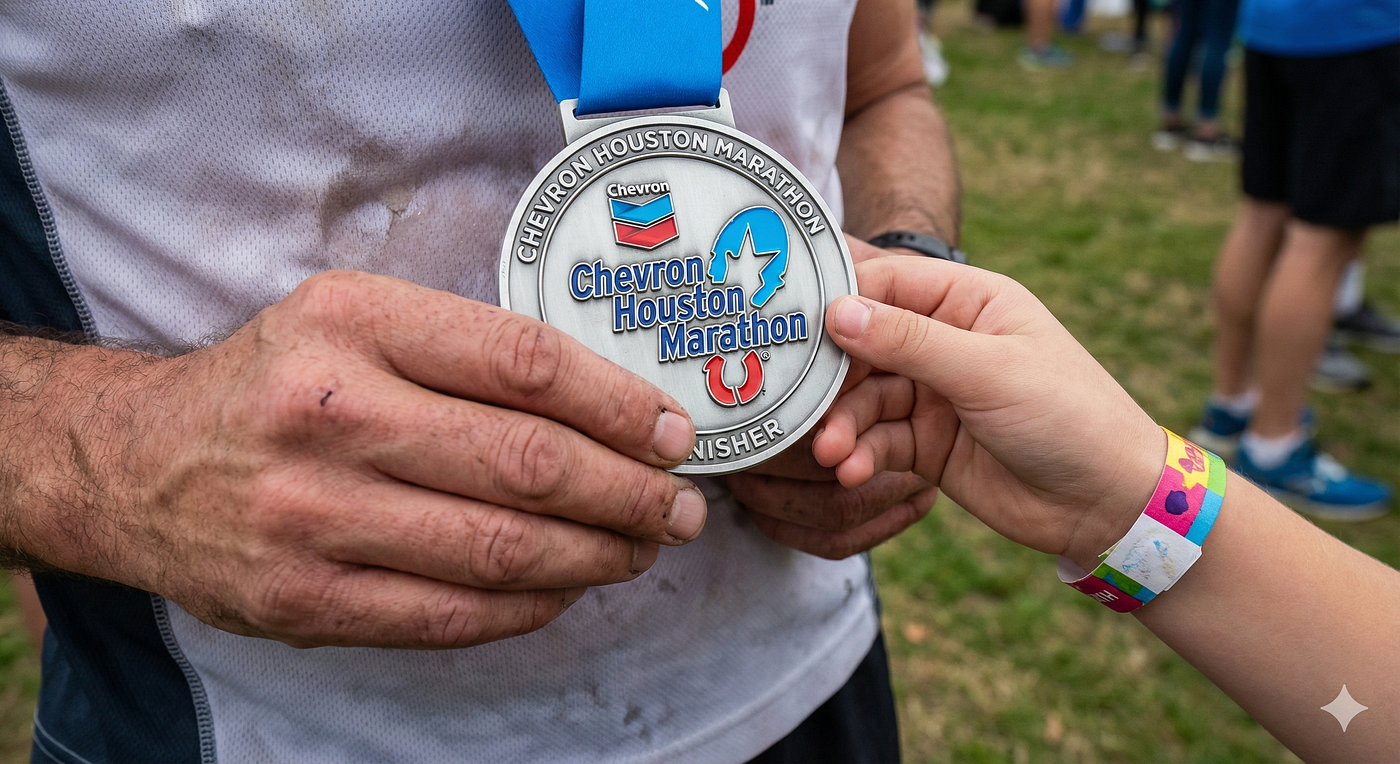
Yesterday, I crossed the finish line of the Chevron Houston Marathon.
Time: 5:11:15.
I thought I had the system figured out. I’d run four half-marathons in 2025 and pushed my training runs up to 20 miles. I fell for the classic marathoner’s fallacy: “If you can run 20, you can run 26. The adrenaline will carry you the rest of the way.”
But a marathon isn’t a linear progression. It’s a stress test that reveals every hidden vulnerability in your logic.
The Mile 13 Over-Clocking
Everything was holding steady until the halfway mark. At mile 13, I hit a massive overpass. In a surge of misplaced confidence, I decided to “conquer” it. I powered up, shouted at the top, and felt like a champion.
It was a tactical error. I gassed out immediately after. I had over-leveraged my energy reserves on a single incline, and the system started to spiral. By the time I leveled off, the realization hit me: “I’m only halfway, and I’ve already spent the ‘adrenaline’ everyone promised me.”
The Mile 15 Reboot
If mile 13 was the crash, mile 15 was the recovery. I made a split-second decision to force down an energy waffle, but the real “glucose surge” didn’t come from the food. It came from seeing my wife and kids.
In my H-Town write-up, I said that anything can be done if we do it as a family. Seeing them there reminded me that I wasn’t just a runner managing a pace; I was a father on a mission. That serotonin hit was the only reason I found the strength to push into the “Loneliest Miles.”
The 20-Mile Reality
The “20-mile rule” is a lie. When I hit mile 20 and saw my mom, I didn’t have a hero’s speech ready. I told her the truth: this was the most painful thing I’d ever done.
There was no adrenaline left — just grit and a pair of earbuds. I spent the final hour in a world of my own, using rhythmic verbal chanting and heavy bass to keep my legs moving when the system wanted to shut down. This is where the “obsession” kicks in. Most people see an obsession as a liability, but in those final six miles, it became my superpower. It allowed me to narrow my entire universe down to the next step.
2026: The “Lab Year”
I’m proud of this finish, but as an engineer, I’m not satisfied with a system that barely clears the finish line on a prayer.
2026 will be my “Lab Year.” I’m heading to a sports hospital for a VO2 Max and gait evaluation. I’m playing the long game now, rebuilding my strike to a mid-foot land. It’s a total refactor of my “code.” I’m willing to feel like I’m learning to walk all over again if it means I can keep doing this for my family for decades to come.
The Mission
I didn’t need to be the fastest person on the course to be the superhero my kids see. I just had to show them what happens when your plan fails, your body hurts, and you still have six miles to go. You don’t quit. You adjust the system, you lean on your people, and you finish.
To anyone else with a “defect” or a goal that feels impossible: it’s just fuel for the mission.
26.2 is done. Now, we go to the lab.