
The Late Game
It’s 9:15 p.m. on a Wednesday. The outfield lights buzz. Mosquitoes drift in lazy figure-eights. A handful of parents sit slumped in folding chairs, one scrolling email, another clapping out of obligation.
Down on the field, a boy swings half-heartedly, his body still trying to obey a bedtime it missed an hour ago. The game started at 7:30. It’s supposed to run two hours, but we all know that’s optimistic.
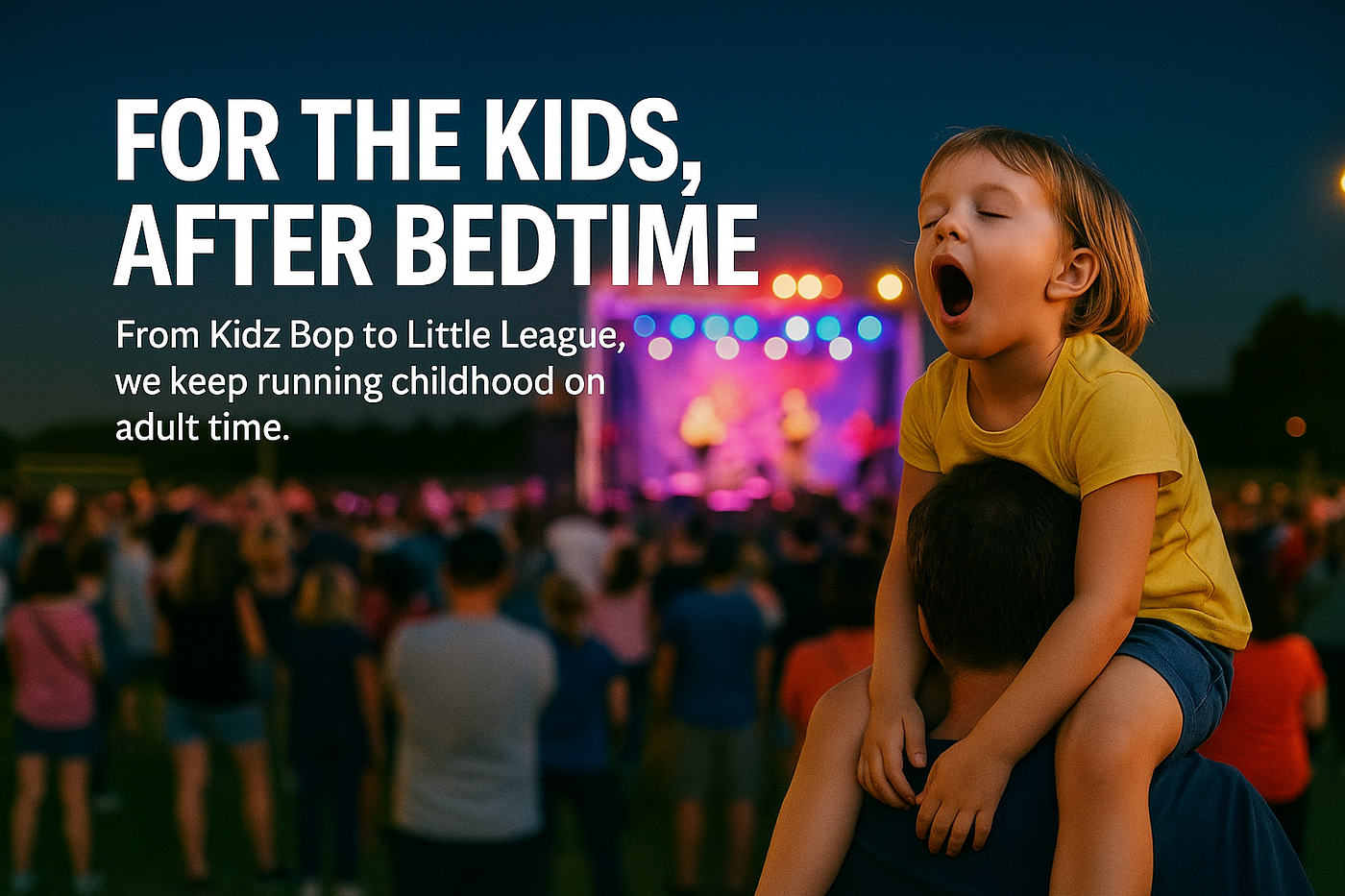
Earlier that week I’d seen a flyer for a Kidz Bop concert — Sunday night, 8 p.m. A show for kids, scheduled at a time no parent of a seven-year-old would reasonably choose.
These two scenes — the night game and the late concert — share a strange symmetry. Both are branded as family fun, yet both unfold on a schedule that works better for adults than for children.
If this is for the kids, why does it run on adult time?
From Commons to Convenience
Not that long ago, public life worked differently. In small towns and less developed communities, kids weren’t a scheduling problem — they were part of the package. If there was a parade, a church dinner, or a local concert, everyone went. Parents didn’t outsource community; they brought their kids into it.
The lack of alternatives created what you might call a temporal commons — shared time that belonged to everyone, regardless of age.
Today, that commons has collapsed under the weight of abundance. Parents have options. Grandparents nearby. Babysitters on apps. Streaming services, indoor gyms, flexible hours, after-school care.
It’s never been easier to keep your child occupied — and never harder to find something genuinely built for them.
The Optionality Paradox
That abundance of choice created a quiet paradox:the more flexible adults became, the less included children were.
Late concerts, weekend tournaments, evening games — whether it’s Kidz Bop or Little League, the pattern is the same. Childhood runs on adult time.
What once revolved around children’s rhythms now orbits around grown-up availability: commutes, workdays, venue economics. It’s not neglect; it’s optimization. We’ve engineered childhood out of the family schedule not because we don’t care, but because we’re efficient.
And when optimization becomes the dominant logic, the “family event” becomes a category error — something that includes children, but isn’t for them.
Orwell’s Mirror – When Childhood Becomes Managed Time
“It was almost normal for people over thirty to be frightened of their own children.”— George Orwell, 1984
Orwell wasn’t talking about Little League or Kidz Bop, but his insight still hits close. In 1984, adults came to fear the unpredictable nature of youth — their questions, their disobedience, their energy. Control became the goal.
We may not fear rebellion anymore, but we do fear inconvenience.We fear the kid who resists the itinerary. The child who still wants to play after the whistle blows. The one who isn’t ready for bed on command because the system runs late.
Modern childhood has become a managed process. Every hour is accounted for: school, homework, sport, screen, sleep. The playground has become an itinerary — a place we schedule rather than inhabit.
“The whole status of children has improved, partly because they have grown relatively less numerous.”— George Orwell, “Such, Such Were the Joys”
In wealthier societies, there are fewer children, and each becomes more precious — but also more controlled. With fewer children and more structure, the spontaneous, shared experience of “community childhood” disappears.
Orwell’s observation lands like a quiet warning — improvement isn’t the same as belonging.
The Biological Mismatch
Biology, of course, didn’t get the memo.A child’s circadian rhythm peaks early. Physical exertion at night floods the body with cortisol, delaying melatonin and pushing bedtime hours later.
By Thursday morning, the 10-year-old shortstop is bleary-eyed in math class while adults congratulate themselves on “team spirit.”
We excuse it because “that’s when the fields are free” or “that’s how the league runs.”But systems have inertia. They will keep running, even when they start running over the people they’re supposed to serve.
That’s the quiet warning Orwell left us: when systems value order and efficiency over lived experience, it’s not always tyranny — sometimes it’s just Wednesday-night baseball and a Sunday-night concert.
The Feedback Loop of Disenchantment
This isn’t about class or access. My family is fortunate — flexible jobs, one parent at home, all the privileges that make late games and concerts logistically possible.
And yet, we’ve started to wonder if we should walk away. Not because it’s hard to make it work, but because it’s no longer for the kids.
That’s the loop few people talk about:
- The schedule stretches later to accommodate adult logistics.
- Families who prioritize their children’s wellbeing quietly drop out.
- The remaining families normalize the new hours.
- Organizers assume it “works fine” — because no one’s complaining anymore.
Each turn of that loop makes the culture more adult-centric. Fewer kids → more scheduling freedom → even later games and shows.
It’s not neglect. It’s drift.
Communities don’t lose their child-friendliness overnight; they wear it away by convenience.
Rediscovering the Temporal Commons
So what would it look like to rebuild that shared sense of time — to design community life around the biological and emotional rhythms of children again?
It doesn’t take sweeping policy. It takes small, visible corrections:
- Games that end before bedtime.
- Events timed for daylight instead of adult commutes.
- Practices that balance competition with play.
- Organizers asking a simple question:“Would this schedule make a 9-year-old excited or overtired?”
Those changes aren’t nostalgic. They’re humane. They re-center the people the activity was built for.
Reclaiming the temporal commons isn’t about turning back the clock. It’s about remembering that time is the one resource kids can’t manage for themselves. We either protect it for them, or we teach them that their needs always come second.
The Field Lights as a Mirror
The game ends close to 9:45.Kids shuffle off the field, too tired to celebrate. Parents collapse chairs, toss snack wrappers, pack coolers. The parking lot glows with brake lights.
Tomorrow, everyone will wake up early and do it again.
From the concert stage to the baseball field, we keep building childhood experiences that end after bedtime.
And sometimes I think about Orwell’s quiet test: a society reveals itself in how it treats its children.
If that’s true, what do the late games and Sunday-night shows say about us?Maybe the real scoreboard isn’t on the outfield wall or the concert marquee — it’s in how tired our kids are on Monday morning.